Showing posts with label desifood. Show all posts

Monday, May 4, 2020

SAMOSA CHAAT

Samosa Chaat. This is a dish that like the demonstration of liquefying cheddar on anything—would need to make a decent attempt to be terrible. It's made of a base of cleaved up samosas (flavorful singed cakes loaded up with fiery potatoes and peas), and beat with chutney, yogurt, and sev (those slight seared potato bits)

There are huge amounts of various sorts, and legitimate strategies for eating each. In any case, at its center, any chaat dish is only a mix of a five basic segments, every one of which adds to making an addictive blend of flavors and surfaces:

1. The Base: This is generally a carb, be it a samosa, a papdi (seared flour wafer), or puffed rice—yet it's regularly fresh. This is the base whereupon every single other flavor will be heaped on. Once in a while the base will be impartial (puffed rice, papdi), or it will as of now be spiced (samosa)— in any case, more seasonings will be included.

2. The Sauces: Cilantro-mint chutney and tamarind chutney are the two most normal sauces in chaat, as they loan hot and tart/sweet components, separately. Plain yogurt additionally joins the gathering, to include a cooling, invigorating note.

3. The Crunch: Besides the base (which frequently gets delicate when stacked up with chutneys), chaat dishes will have other crunchy fixings like slim sev—minimal zesty bits of seared potato—or masala chana—singed, spiced chickpeas.

4. The Vegetables: Diced onions, tomatoes, and potatoes figure intensely in chaat. The potatoes are normally essentially bubbled, and the tomatoes and onions are crude—these are intended to include surface.

5. The Umami: Almost all chaat incorporates a sprinkling of chaat masala, a universal Indian flavor mix that scents like spoiled eggs yet adds a shock of umami to any dish.

DAL CHAWAL


Daal Chawal is a Pakistani dish that is also common in India. lentils. It is quite a simple dish but delicious.
There are many types of lentils green peas, white peas, red lentils, black grams beans and many more. Lentils are boiled and cooked with a mixture of spices and  then at the end given a ‘tarka’ of spices. These spices are mixed on pan in oil or ghee and then poured at the top of daal. It gives daal aroma and a mixture of flavours. Daal is also cooked in mud utensils and it also changes its taste.
It is served with boiled rice, naan, roti. You can also add cumin seeds in boiled rice.
Some people eat daal chawal with hands some use a spoon and some people also use fork, everyone has their own preferences. Daal Chawal is also good for weight loss as it is low in carbs and high in fiber.
The best daal I had was from a road side restaurant named ‘Mian jee restaurant lalamussa’. They have their own signature recipe and they are famous for their daal.
Daal is served with salad, pickle, raita to spice it up.

GOL GUPPAY

Gol Gappay
Gol gappay also known as pani Puri is a type of snack that is also originated in Indian sub-continent. In India it is known as pani puri and in Pakistan as gol gappay and many other names depending on the region. It is also quite common in Pakistan. If you roam around in streets of Pakistan you will find many vendors selling gol gappay. But not all of them have a tempting taste. A good stop for gol gappay is difficult to find. I’m always looking for delicious gol gappay and the best one I had was in Rawal Pindi. It is a quite pocket friendly snack.
It consists of a round, hollow, ball-shaped puri filled with a mixture of various chutneys, chick peas, potato, onions with a tangy flavoured water. It is served in various ways sweet, sour or a mixture of both.
The trick is to put the entire gol gappa in your mouth without cracking it.It is a bit messy to eat. As I have observed this snack is more liked among girls.  


BIRYANI


Pakistan has marvelous dishes full of spices and phenomenal aromas that can easily induce hunger.
There are tons of different ways to cook one single dish by changing spices or cooking techniques as every region has its own special way of cooking, therefore Pakistan has diverse variety of food.
There are some dishes that are very easy to make and quick (karahi) and some dishes require hours to cook (haleem, paye).
Everyone has their own way of enjoying food, some prefer it with naan or roti and some prefer it with rice.


Biryani has its origin from Indian sub-continent however it is among the most traditional dishes of Pakistan and known in other regions as well. Ingredients vary from region to region. The exact origin of biryani is unknown.
This Rice-based  food is full of spices. The most common is chicken and beef biryani  however it is also cooked with fish, eggs, vegetable ,prawns.
It is made by mixing curry in semi-cooked rice separately. If you  jump on youtube or google you will find many types of recipes each guiding you to a different type of Biryani.
As Karachiites are known for their excellent cooking abilities, you will always hear a person from Karachi that this biryani is nothing like biryani from Karachi. 
Biryani is always served with raita (yogurt mixed with cumin seeds, black pepper and salt) and salad. If you are a foreigner don’t miss having biryani.                              

HALEEM

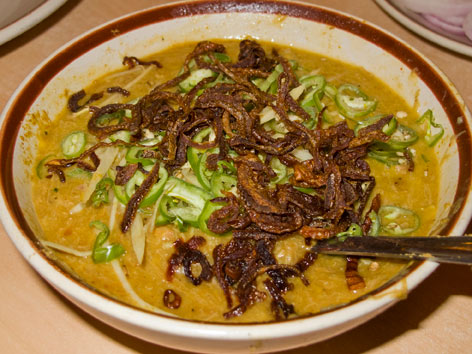
Haleem is a sort of thick well known dish in the Middle East, Central Asia, and the Indian subcontinent. Despite the fact that the dish changes from area to area, it alternatively incorporates wheat or grain, meat and lentils. Well known varieties incorporate keşkek in Turkey, Iran, Afghanistan, Tajikistan, Uzbekistan, Azerbaijan and northern Iraq; Hareesa in the Arab world and Armenia; Halim in Bangladesh and West Bengal, India; Khichra in Pakistan and India.

Haleem is made of wheat, grain, meat: generally minced hamburger or sheep; goat meat; or Lamb and sheep; or chicken, lentils and flavors. Some of the time rice is likewise utilized. This dish is moderate cooked for seven to eight hours, which brings about a glue like consistency, mixing the kinds of flavors, meat, grain and wheat.

Haleem is sold as a nibble nourishment in bazaars consistently. It is likewise an exceptional dish arranged all through the world during the Ramadan and Muharram months of the Muslim Hijri schedule, especially among Pakistanis and Indian Muslims.

Moreover, Haleem is  exceptionally mainstream in Bangladesh, particularly during the holy month of Ramadan, when it is a staple dish.In Pakistan, Haleem is accessible lasting through the year, just as in most Pakistani eateries around the globe.

 Haleem is made by right off the dried up wheat, grain and gram lentil short-term. A fiery meat sauce called Korma is set up until the meat gets delicate. The wheat, grain and gram are bubbled in salt water until they are delicate. The cooked wheat, grain and lentils are then blended in with the meat (Beef or Mutton or Chicken) sauce and mixed with a substantial hand blender to get a glue like cpattern. The cooking method takes around 6 hours to finish. Be that as it may, haleem planning shifts in various locales is sold as a nibble nourishment and road nourishment in Pakistani bazaars consistently.

CHICKEN KACHORI

Chicken kachori:
is one of the main item people use to have in holy month of Ramadan. 
Basically the origin of kachori is from Uttar, Pradesh India. The recipe is simple but most of the people are not able to make it because its a time taking process. 
 This is made up of boiled chicken and some vegetables, the vegetables which are used are peas, cabbage, carrot,  coriander and green chilli. All the vegetables are chopped well and the mixed with the small pieces of boiled chicken and then some spices are add to it to make the taste better. After mixing this all, this mixture is used to fill up the small strips of white flour and give it a shape of a circle.
The final step is to stirred fry them. After being  fried the outer shell will be harder as compare to the inner one. These kachori’s can easily be bought from any sweet or bakers all across Pakistan   

Monday, March 23, 2020

CHAPLI KABAB


Peshawari Chapli Kabab
Imagine you travel to Khyber Pakhtun Khwa and miss the traditional foods of there during your stay. Definitely no one would want to do that. And when you think of the traditional foods of there, the first common thing that comes to your or anyone’s mind is Chapli kebab.
Chapli Kebab is a Mughlai-influenced minced kebab, usually made from ground beef, mutton or chicken with various spices in a shape of a patty. It was originated in Peshawar and hence also known as Peshawari Kebab/Kabab
The Chapli Kebab is a famous and one of the most loved street food across Khyber Pakhtunkhwa. And not just in that particular province but in whole Pakistan and across the borders such as in Afghanistan and India. An interesting fact about this dish is the different ways in which different people consume it. The most common ways of eating that is followed by Pashtun people and other locals in Pakistan is eating the Kebab with Naan (A yeast loaf). Other people also enjoy this as a burger patty or sandwich patty between breads or buns.  

The recipe includes the ground meat with a calculated amount of spices and tomatoes in rich quantity. Fried in a large pan filled with cooking oil and are served hot.

After it's cooked, chapli kebabs can be served with chopped onions and tomatoes, along with other ingredients such as various chutney sauces in which mint sauce is commonly used in Pakistan. Other than that salad, yogurt, pickles or nuts are also used to serve this dish. The chapli kebab is preferred aromatic and spicy. And the taste buds feel more pleased when you have a cold drink with it. So, if you ever have a chance to visit Khyber Pakhtunkhwa, never miss this incredible dish.